
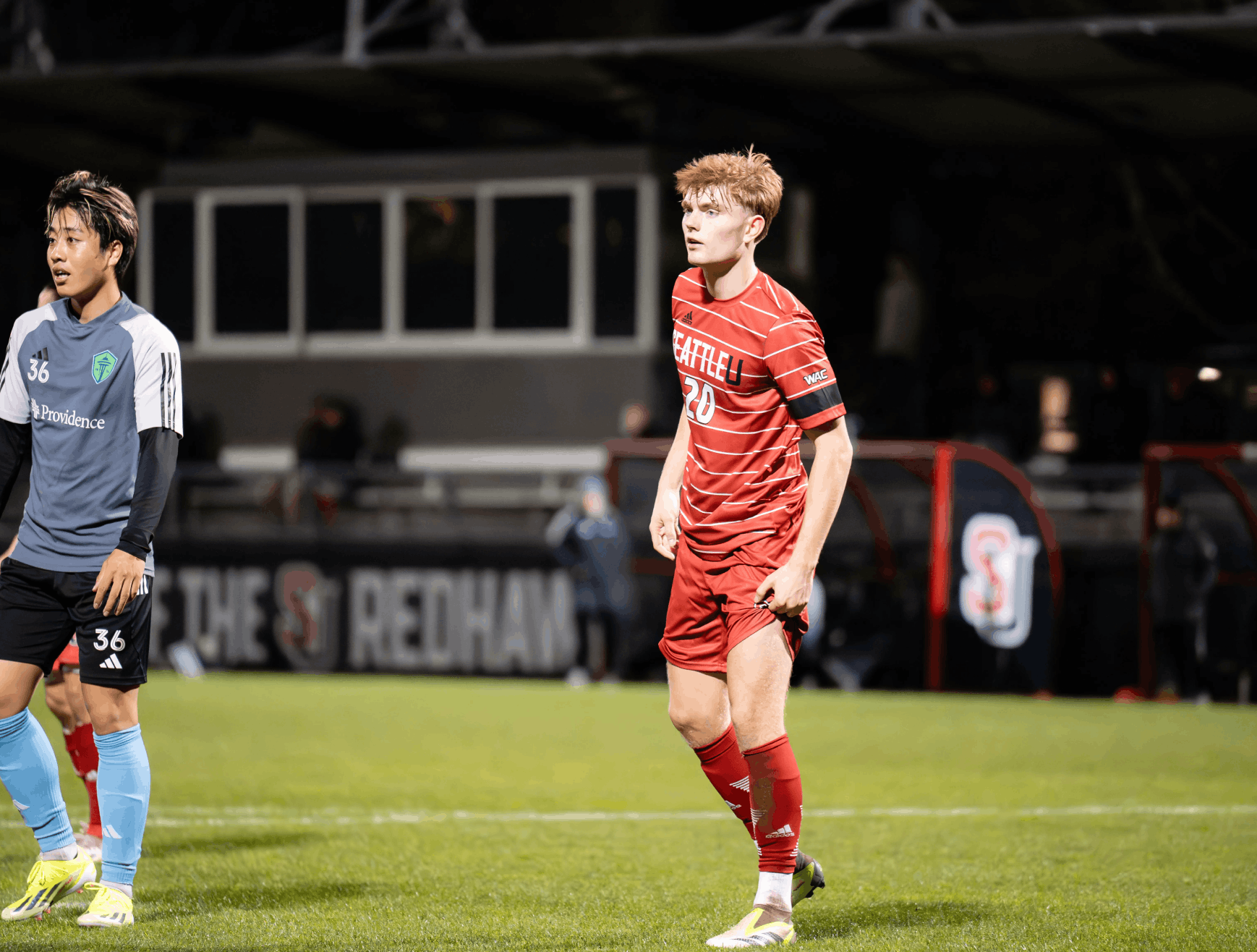
For many student-athletes, Division I soccer is the dream. But behind the signing posts and matchday photos is a much more demanding reality. In this replay recap, Seattle University senior Dane Lanning shares an honest account of what college soccer actually looks like, and why the experience shapes far more than just the player.
For a lot of young footballers, Division I soccer is imagined in snapshots.
A scholarship graphic. A packed stadium. A team tracksuit. A highlight clip under lights.
What gets lost in that picture is everything that sits underneath it.
That was what made this conversation with Dane Lanning so valuable.
Dane is in his senior year at Seattle University, having come through one of the top youth club environments in the United States before stepping into Division I soccer himself. He knows the pathway from the inside, not just from the recruitment side, but from the day-to-day reality of living it.
And the clearest message from the replay was that college soccer is not something you casually arrive into.
It is structured. It is demanding. It is constant.
Preseason begins before classes even start. Fitness matters immediately. Schedules are built around training blocks, team meetings, film sessions, treatment, recovery, lifts, travel, and classes. Players are not only preparing for matches, they are learning how to function inside a professional-level environment while still carrying the identity of a student.
That is the part many younger athletes do not fully see.
The soccer side is intense enough on its own. But the full experience is much bigger than just what happens during a ninety-minute match. It is waking up early for training, learning how to balance academic responsibilities, managing setbacks, showing up properly when things are not going well, and understanding that everything matters. Habits. Attitude. Recovery. Communication. Consistency.
Dane spoke openly about that pressure, but he also spoke about something more important: growth.
His own athletic journey at Seattle University did not unfold the way he had imagined. Injuries interrupted key moments of his college career and changed what he thought those four years would look like on the field. But what came through strongly was that the value of college sport does not disappear just because the sporting path becomes harder than expected.
If anything, the opposite can happen.
College forces growth quickly. It tests identity, resilience, maturity, and perspective. It puts athletes in environments where they are surrounded by people going through the same transition, all trying to build something, all learning how to carry themselves, all living far more independently than they ever have before.
That is part of what makes the experience so powerful.
Dane also touched on one of the biggest misconceptions young athletes have: that choosing a school is simply about finding the biggest name possible. From his perspective, and from what he has seen firsthand, fit matters more than status if the goal is to actually develop and play.
A top-ranked program might look impressive from a distance, but if an athlete ends up buried on the bench with no real role, that experience becomes much harder to justify. The better question is not always, “What is the biggest school I can get into?” It is, “Where can I compete, contribute, and grow?”
That same honesty carried through when he spoke about the broader college environment.
Yes, the demands are real. Yes, the pressure is high. But so are the rewards. Relationships become deeper because teammates spend so much time together. Athletic departments become ecosystems where students, coaches, trainers, tutors, and support staff all know who you are. Campus identity becomes real. So does pride in representing something bigger than yourself.
That is what many international athletes end up discovering.
They leave home expecting sport and study. What they often get as well is a version of adulthood accelerated through community, responsibility, and challenge.
This replay was not about selling the dream.
It was about showing the reality, and why the reality is still worth it.
For the right athlete, Division I soccer can be one of the most demanding things they ever commit to.
It can also be one of the most formative.
If you’re a student-athlete (or a parent of one) and want to explore similar opportunities through the U.S. college system, let’s talk.
