
There is still a tendency in junior golf to believe that more is always better.
More balls. More range time. More tournaments. More hours.
For a long time, that approach was almost worn as a badge of honour. If a young player was willing to spend entire days grinding at the range, it was seen as proof of commitment. But as golf continues to evolve, so does the understanding of what actually builds high-level performance.
That was one of the clearest takeaways from our recent conversation with Adam Weeks, Director of Fit to Play Golf.
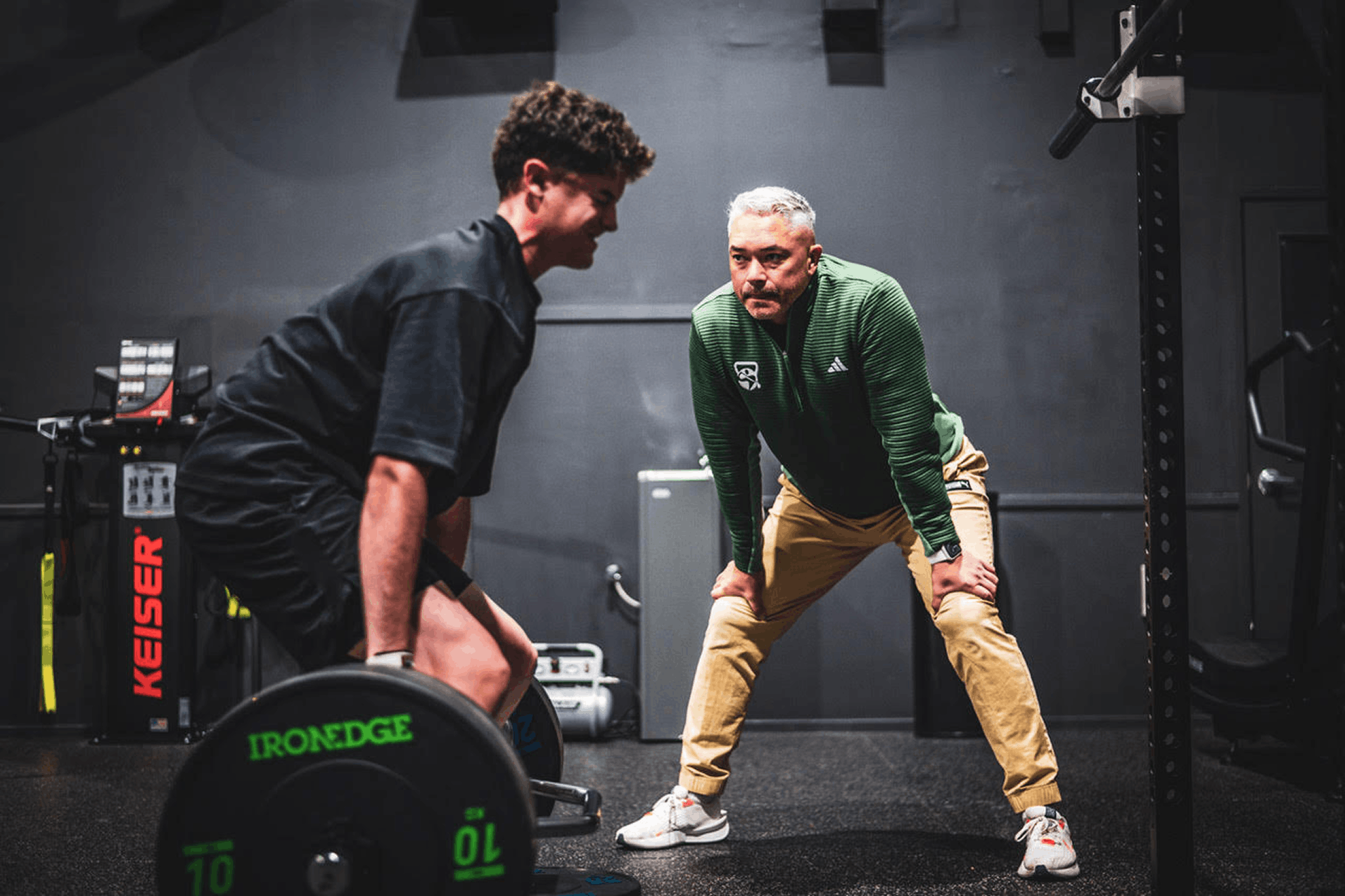
Adam works in the space where golf, movement, strength, and performance all meet. His focus is not just on helping golfers swing faster or hit it further, but on preparing them to meet the physical demands of the sport over time. For young players considering the U.S. college pathway, that matters more than ever.
Because while scores remain central to golf recruiting, they are no longer the whole story.
College coaches are not just looking at whether a player can produce one good round. They are also looking at whether that player can handle a training environment, stay available, recover properly, and compete repeatedly under physical and mental load. In a college program, golfers are not simply turning up to play one event every now and then. They are training, qualifying, travelling, studying, lifting, recovering, and competing against their own teammates every week.
Durability becomes part of performance.
Adam spoke about one of the most common mistakes he sees in junior golf: quantity over quality. Many young players are still spending endless hours hitting balls without enough understanding of how their bodies are moving, what stress that repetition is creating, or how to build the physical foundation required to actually support their game.
That often shows up in the same places. Low backs. Wrists. Elbows. Shoulders.
Not because these athletes do not care enough, but because many are trying to create speed or control through the wrong parts of the body, or are simply doing too much without enough support around them. Golf may not look like a collision sport, but it is still physically demanding, especially when played at volume and under pressure.
This is where the conversation becomes broader than just injury prevention.
Physical preparation is not only about avoiding breakdown. It is about helping young golfers become more complete athletes. It means building strength and rotational control. It means understanding load. It means periodising training rather than approaching every week the same way. It means knowing when to push, when to maintain, and when to recover.
It also means recognising that college golf does not wait for players to figure this out later.
The reality is that the stronger college programs expect athletes to arrive with a base level of physical competence already in place. Team lifts are standard. Conditioning is standard. Schedule demands are real. Players who have never stepped into a gym properly, never built routines around mobility and recovery, or never learned how to manage their bodies through travel and tournament play can quickly find themselves behind.
Adam also raised an important point around tournament scheduling and development.
Playing tournaments matters, but over-competing can flatten progress just as easily as under-preparing. Not every event carries the same weight, and not every week should look the same. Strong planning matters. So does understanding what each part of the season is for. Some periods should prioritise performance. Others should prioritise development. Others should be about maintenance and recovery.
For many families, that can be difficult to navigate, especially alongside school, travel, and the normal pressures of teenage life. That is why the best outcomes often come when young athletes are supported by a wider team, not just left to piece everything together themselves.
Sleep, hydration, nutrition, mobility, and mental readiness were all part of the discussion too, and for good reason. Golf may be slower-paced than many sports, but that often means there is more time to think, more time to dwell, and more time for lapses in focus to become costly. If a player is mentally flat, under-fuelled, dehydrated, or physically fatigued, poor decisions can begin to show up just as quickly as poor swings.
That is why college readiness in golf is not just about who hits it best.
It is about who can sustain their level.
The encouraging part is that this can be developed. The young golfers already putting in the effort are not far off. But effort needs direction. Practice needs support. Talent needs structure.
That is ultimately what this conversation was about.
Not changing the ambition, but preparing the athlete behind it.
If you’re a student-athlete (or a parent of one) and want to explore similar opportunities through the U.S. college system, let’s talk.
