
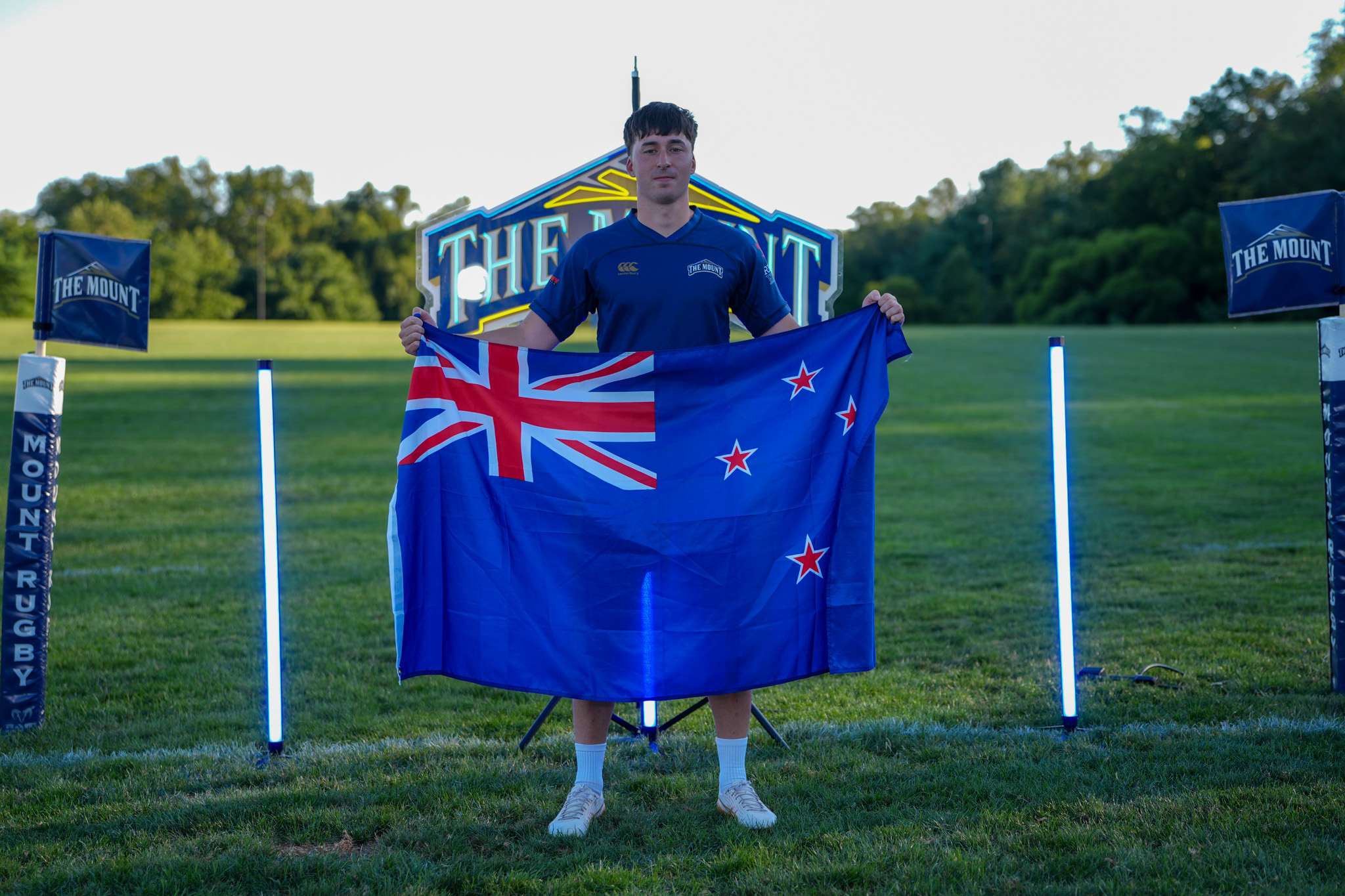
Logan Wild was not chasing a scholarship when he started looking into college rugby.
He was a teenager at Massey High School in Auckland, searching YouTube one evening, and came across footage of American college rugby. He watched a bit more. Then a bit more. Then he went to his parents and said he wanted to look into it seriously.
His parents were hesitant at first. They did not know what the pathway involved. But once they started researching alongside him, they came around. Neither of them had any frame of reference for what he was walking into. Neither did Logan.
"I honestly didn't really know what I was getting myself into," he says now. "But looking back on it, I think it was probably a good decision. And if I had the opportunity to do it again, I would."
Logan recently returned to New Zealand having graduated from Mount St. Mary's University in Maryland, a Division I programme about 40 minutes from Washington DC, with a degree in business marketing and sports management. He played three years of college rugby, trained under coaches with Super Rugby and MLR experience, competed against some of the strongest programmes in the country, and came back a different player and a different person than the one who left.
His story is not unusual in its shape. But it is worth telling in its detail, because the detail is where the value of the college pathway actually lives.
When Logan told his mates in Auckland he was going to America to play rugby, the reaction was confusion more than anything else.
"When you hear rugby and then hear America, no one thinks they play over there," he says. "Like obviously I didn't think they played over there either."
Rugby in the United States exists largely below the radar of the New Zealand sporting conversation. The MLR has been growing steadily, and names like Martin Monu of San Diego Legion have made the move. Some Super Rugby players use the off-season to play stints in New York or DC. But the coverage is limited, and for most young athletes in New Zealand, the American college rugby scene is effectively invisible until someone points them toward it.
Mount St. Mary's sits in the Blue Ridge Mountains of Maryland. The campus is perched on a hilltop, with a large gold statue of Mary visible from across the grounds. Logan describes it as the kind of place that, if you saw a photo, you would be impressed. It is a small, tight community by American university standards, which suited him.
"It's beautiful," he says. "Honestly, like if you saw a picture you would probably be impressed."
The facilities were another level. Three rugby fields, a full-size pool, multiple athletic training rooms, ice baths, recovery equipment, a full gym operation. Everything that a serious athlete could need, invested in because American universities understand that athletic infrastructure is part of how they attract and develop talent.
"The facilities are better than most professional facilities here," Logan says. "Even for professional teams."
One of the more surprising aspects of Logan's experience at Mount St. Mary's was the quality of the coaching staff he trained under.
His programme had four coaches, three of whom were full-time, spending their days researching, analysing opponents, developing new strategies, and working on the team's development with a focus that exceeded what most young New Zealand players would have access to at home.
Over the course of his time there, former Highlanders Super Rugby player Jason Emery came for a semester to work with the squad, bringing experience from his career across Super Rugby, the Japanese leagues, and MLR. The programme also had connections to Old Glory DC, the MLR team based in the Washington area, with coaches from that environment coming down to contribute sessions.
"We're getting all this knowledge that honestly, I didn't expect it," Logan says. "You can't really get better than that."
For a young player who had trained two or three times a week at high school in New Zealand, arriving at an environment where rugby occupied five training days a week, multiple hours of contact per session, film review, gym work, and tactical preparation every week was a significant shift.
"From what I was when I left New Zealand to what I am now, I'm 100% a better player," he says without hesitation. "You're touching the ball so much more. You're thinking about rugby 24/7."
Logan was dropped off at the Mount St. Mary's campus by his parents, who came over for the first week and saw the school before heading home. He watched their car drive away. And then it landed.
"I stood there and I was like, oh damn. Whatever I got myself into."
It is a moment many families think about in the lead-up to a departure but rarely discuss openly. The logistics of the pathway, the scholarship, the coach calls, the footage, the paperwork, can fill up so much of the preparation period that the emotional reality of what it means to send a young person eighteen hours away to an unfamiliar country, alone, sometimes gets underweighted.
Logan is honest that his parents felt it even more than he did. His mother cried. He noticed, for the first time, that not seeing them for a long stretch of time was going to feel different from the inside than it had sounded from the outside.
But he stuck it out. And what he found on the other side of that initial difficulty was the thing that consistently comes through in conversations with athletes who have done what he did.
"You learn so many life skills that it could take someone years to learn. I grew more as a person than what I learned in the books or on the field."
One detail from Logan's recruitment conversation is worth passing on to any athlete currently going through the process.
His college coach, based in Maryland, would arrange calls at times that landed at four or five in the morning for Logan in Auckland. Logan made every one of them. He got up, turned on his camera, and showed up for conversations that sometimes ran well over an hour.
He is not sure whether the coach knew exactly what time it was on Logan's side of the world. What he does know is that those calls shaped how the coach saw him.
"I made the effort," Logan says. "And that showed him that I was dedicated and wanted to do whatever I could to get over there."
For athletes wondering whether small things matter in the recruitment process, this is a useful reminder. Coaches are evaluating character and commitment well before any offer is made. An athlete who reschedules because the time is inconvenient sends a different message than one who sets an alarm for four in the morning and shows up ready.
Logan graduated in three years, finishing his degree in business marketing and sports management. He came back to Auckland, rejoined his club, and is now looking at the MLR draft as a potential next step.
He is twenty-two. He has a degree, three years of high-level rugby development, a network of teammates from across the world, and a clear-eyed view of what the professional pathway looks like from someone who has already taken one of its more unusual routes.
"There are four professional teams in New Zealand and however many rugby players wanting to play professional," he says. "So look at the different opportunities around the world. There's more than just New Zealand."
It is the most practical piece of advice he has to offer young players in New Zealand who want to play professional rugby and are staring at a very small number of available pathways at home. The college system is not a detour. For athletes like Logan, it is a development environment, an academic qualification, and a platform for what comes next.
"You're never going to actually know if you never do it."
If you are a student-athlete or parent thinking about the U.S. college rugby pathway, start with a conversation. Platform Sports can help you understand your options, your timeline, and what the right fit could look like.
