
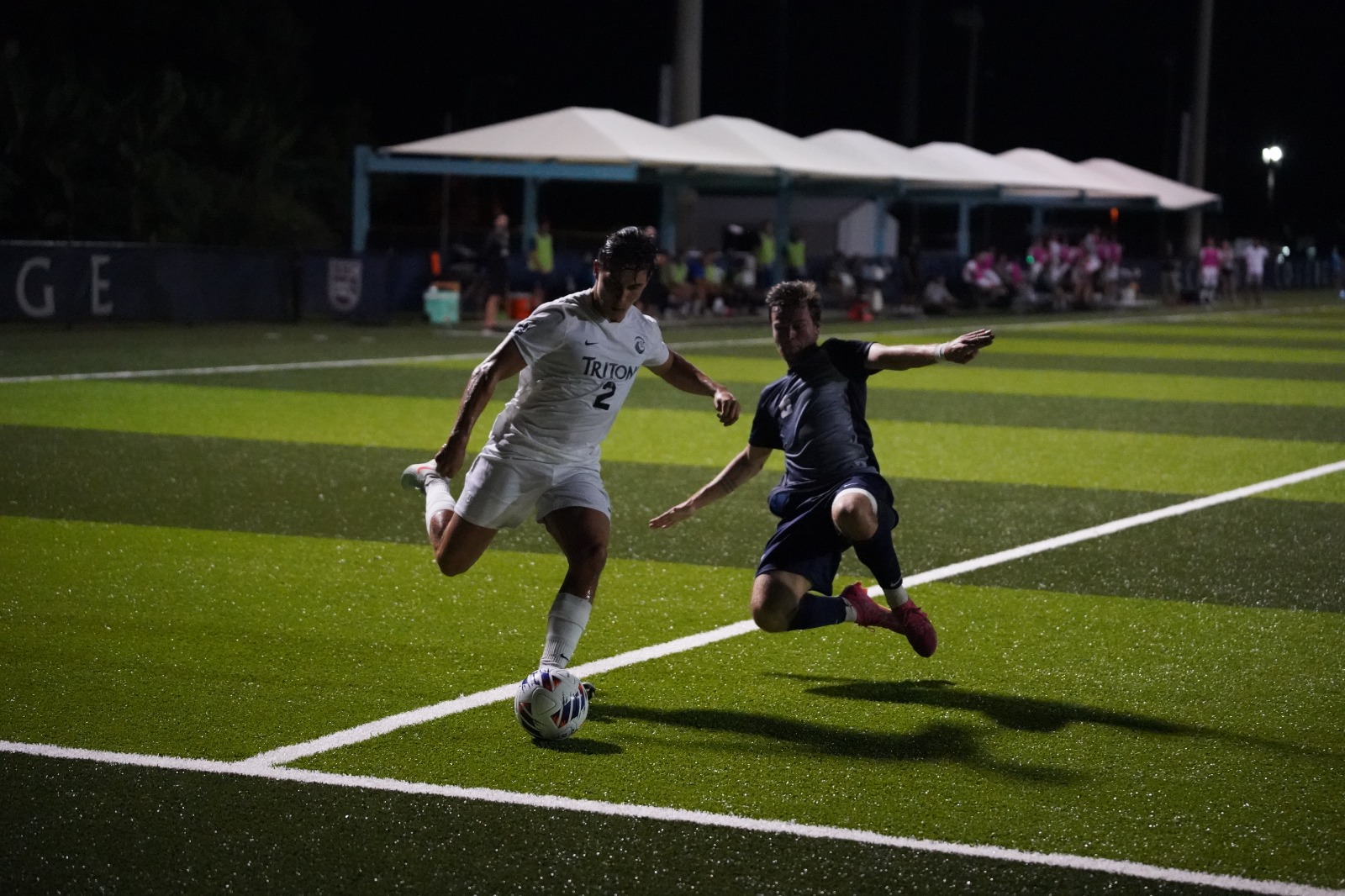
There is a version of the US college soccer pathway that lives on social media.
It looks like this: a Division 1 athlete in a pristine kit, walking out of a state-of-the-art facility, posting highlights from a stadium that holds 20,000 people.It is real. It is also the experience of a very small percentage of the athletes who make this journey every year.
For the rest, the reality is different. Not worse. Just different. And knowing that difference before you start is the thing that changes everything.
In a recent Platform Sports webinar, Connar Mackay, NCAA Division II Soccer Player at Eckerd College in Florida, and Miguel, former US college athlete and Platform Sports recruitment specialist, sat down to talk through what the pathway actually looks like. From the recruiting process to the daily grind, from empty dorm rooms to transfer decisions, this is the conversation most families never get to have before they commit.
Here is what they said.
Start Before You Think You Need To
Connar began reaching out to college coaches at 16. He had time to aim high, make mistakes, reassess, and eventually land in the right place. Miguel found out about the US college pathway at 19, after finishing Year 12 in Australia. By that point, he had unknowingly missed a year of NCAA eligibility. He found out the hard way, after receiving a scholarship offer and going through admissions, only to be told he did not qualify."If I had known earlier, I could have been more targeted," Miguel said. "I would have known which schools were actually available to me."The athletes who start early have options. They have room to trial and error. They can afford to be ambitious without pressure, and they can course correct without panic. The athletes who start late are forced into narrower windows with less leverage.The advice is simple. Start at 15 or 16 if you can. The process rewards early movers.
The Division on the Offer Is Not the Whole Story
One of the most common mistakes athletes make is treating Division 1 as the only acceptable outcome. Connar had interest from Division 1 programs during a transfer period. He turned them down. Not because the level was wrong, but because the programs were not the right fit for him personally. He chose Eckerd College, a strong Division 2 program in the Tampa area, and has no regrets.Miguel started his US career at a junior college in a town of 2,000 people in rural Kansas. He went in with one goal: prove himself. He came out an NJCAA All-American, which opened doors to a program in Florida he never would have accessed otherwise."People throw away the idea of going to college just because they're not getting offers from the schools they see on Instagram," Miguel said. "But you have to earn your stripes. And some of these junior college programs have better facilities than lower-end Division 1 schools. People just don't see that."Division 2, NAIA, and JUCO programs are not consolation prizes. For many athletes, they are the smartest starting point on the way to something bigger.
What a Typical Day Actually Looks Like
Connar trains at 6am because Florida heat makes afternoon sessions brutal in fall season. After training, he moves into classes. After classes, depending on the day, he goes into the training room for treatment, hits the gym for a supplementary lift, or gets an extra session in on his own. Evenings are for study. Bed comes early because the next day starts the same way.There is no meal service waiting for him. No one doing his laundry. No one reminding him to go to the bank or buy groceries. When he first arrived, he had to ask teammates to drive him around because he did not have a car. He had to figure out how to open a bank account in a new country, get a new phone number, and settle into a university life while also settling into a new country."You're an adult the moment you arrive," Connar said. "Whether you're 18 or 21, it's your responsibility to look after yourself. No one else will."This is not a warning. It is a preparation. Athletes who go in knowing this tend to handle it well. Athletes who expect the experience to mirror what they see on social media often find the gap between expectation and reality difficult to close.
Coaches Are Salespeople. Treat Every Call Accordingly.
College coaches have one job in the recruiting process: bring in the best players they can for as little of their budget as possible. They are skilled at it. They will tell you everything that is great about their program. They will not volunteer the information that works against them.They will not tell you that the nearest airport is a two-hour drive away. They will not mention that the roster is stacked in your position for the next two years. They will not bring up the November away trips that take 14 hours by bus."A coach won't tell you it takes 45 minutes through snow to reach the nearest grocery store," Connar said. "Because they're trying to convince you to sign."The advice from both Connar and Miguel is consistent: treat every coach conversation as a two-way interview. Go in with your own questions. Research the roster before the call. Check how many players in your position are graduating. Look at the school's location on a map. Text current international players on the roster. Ask what the environment is actually like to live in, not just to play in.The athletes who do this make better decisions. The athletes who get swept up in the pitch often find themselves in the wrong place.
Your Grades Are a Scholarship Tool
This point is underestimated by almost every family that goes through this process for the first time.Academic performance is not just an entry requirement. It is a financial lever. Coaches with strong athletes who also have strong grades can go to their admissions departments and access additional funding that sits outside the athletic budget. At Division 3 programs in particular, where there are no traditional athletic scholarships, academic merit becomes the primary funding mechanism."It could save you genuinely hundreds of thousands of dollars," Connar said. "Don't slack off on your grades just because you think your football will carry you."Athletes who arrive with a strong academic record give their coaches more to work with. Athletes who neglect their studies reduce their own options before they have even started.
Finding the Right Fit Is the Most Important Decision You Will Make
Both Connar and Miguel are clear on this point. The fit of a program, the environment, the coaching staff, the location, the social atmosphere, determines the quality of the entire experience. More than the division. More than the facilities. More than the scholarship number."You will come over here and have two very different experiences depending on whether you just take any school versus a school that you think is going to be the right fit," Connar said. "You can have all the help in the world from anyone and you still might not know until you get there. But you have to do as much as possible beforehand to eliminate that uncertainty." That means looking beyond football and academics. It means asking whether the area suits you. Whether there is a major airport nearby for flights home. Whether the team culture is somewhere you can thrive. Whether the coaching staff is made up of people you genuinely want to spend four years learning from.The athletes who approach this holistically, who treat the decision as a life choice rather than just a sporting one, tend to perform better on the pitch because they are not miserable the moment they leave it.
The Mindset That Makes It Work
The US college pathway asks a lot of athletes. It asks them to leave their families, move to a new country, adapt to a different style of football, manage their own lives for the first time, and perform consistently under pressure across four years.The athletes who make the most of it are the ones who stay hungry after they arrive."Just because you're here doesn't mean you're safe," Connar said. "Players come in every year and they will come and take your spot. You have to come over still wanting more."Miguel puts it another way. The sacrifice belongs to the whole family, not just the athlete. Parents are covering flights, insurance, and living costs while going without their child for most of the year. That weight is real. And for many athletes, remembering that weight is what keeps them going when the experience gets hard."Always remember why you're there in the first place," Miguel said. "And never forget the sacrifice your family is making to support that journey."
What This Pathway Actually Gives You
The question athletes and families ask most often is: what is the return?Connar will finish his time at Eckerd College with a double degree, a significant social media following built around documenting his journey, and a network that stretches across multiple countries and professional levels. He came over to play football at the highest level possible, and to combine that with a world-class education. He has done both.Miguel went through four schools, started at junior college, and came back to Australia a completely different player and person than the one who left. The athletes he was competing against at home when he departed were in the same positions when he returned. He was not."If you stay in Australia, or the UK, or wherever you're from, and just go through the motions, the ceiling is low," Miguel said. "If you put yourself in an environment with more exposure, higher competition, and a bigger network, the ceiling changes completely."The US college pathway does not guarantee a professional career. What it does give athletes, if they approach it correctly, is four years of high-level competition, a quality degree, a network that spans the country and beyond, and a level of personal maturity that is difficult to develop any other way. That is the honest version. And it is still a very good one.
Interested in finding out where you fit in the US college system? Platform Sports offers free consultations for athletes and families at any stage of the process. No pressure. No pitch. Just clarity on your next steps.
Book your free consultation here. https://www.platformsportsmanagement.com/consultation
